IFRS DIPLOMA
International Financial Reporting Standards
Looking to advance your career in accounting, auditing, or financial reporting?
The IFRS Diploma equips you with globally recognized expertise in international standards—helping you interpret, apply, and analyze financial statements with confidence and credibility.
Start Your Journey to Excellence
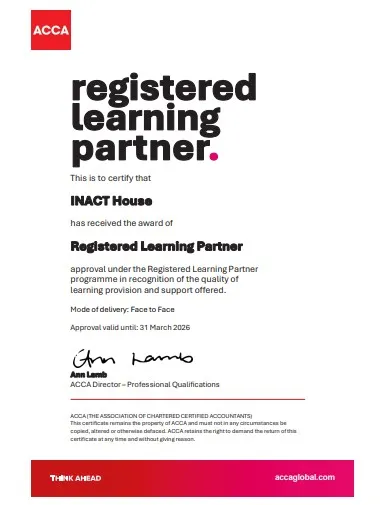
What is the IFRS Diploma?
The IFRS Diploma is an internationally recognized qualification that helps professionals master International Financial Reporting Standards. It enhances your ability to prepare, interpret, and analyze financial statements according to global standards—making you a stronger candidate for accounting, auditing, and finance roles in multinational companies.
✅ Why Choose IFRS ? (Key Benefits)
-
Global Recognition:
IFRS is used in 140+ countries, making your skills valuable for multinational companies. -
Career Growth:
IFRS expertise increases your chances of landing high-level roles in accounting, auditing, and financial reporting. -
High-Quality Reporting:
Helps you prepare accurate, transparent, and internationally compliant financial statements. -
In-Demand Skill:
Companies actively seek professionals who understand international standards and complex reporting requirements. -
Better Decision-Making:
Strong IFRS knowledge enhances financial analysis and supports strategic business decisions. -
Stronger Audit Skills:
Ideal for auditors who want to improve accuracy, compliance, and credibility.
-
Competitive Advantage:
Sets you apart in the job market and boosts your professional credibility.


Course Objectives & What You'll Achieve
By the end of this IFRS DIPLOMA, participants will be able to:
Develop a solid understanding of International Financial Reporting Standards (IFRS) and how global accounting standards are designed, structured, and applied.
Learn to prepare and present IFRS-compliant financial statements, including the Statement of Financial Position, Profit or Loss, Equity, and Cash Flows.
Build strong practical skills in recognition, measurement, presentation, and disclosure across major accounting areas.
Gain hands-on expertise in Group Reporting and Consolidation, including subsidiaries, associates, and joint ventures.
Master essential IFRS topics such as Revenue Recognition, Financial Instruments, PPE, Intangibles, Leases (IFRS 16), Provisions, and Impairment.
Strengthen your ability to interpret and apply accounting policies, estimates, and error corrections while ensuring full IFRS compliance.
Acquire the capability to produce high-quality, transparent financial statements that meet international standards and increase your global employability.
Gain a competitive edge for roles in accounting, auditing, and financial reporting, especially within multinational companies.
IFRS DIP – Content Outline
-
1. Introduction & IFRS Framework
-Introduction to International Financial Reporting Standards (IFRS).
-Overview of the IASB and the global regulatory framework.
-Understanding the Conceptual Framework: assets, liabilities, equity, income, and expenses.
-
2. Elements of Financial Statements (Core IFRS Standards)
Revenue Recognition (IFRS 15)
– principles, measurement, and disclosure. Property, Plant and Equipment (IAS 16) – acquisition, depreciation, revaluation, and disposal.
Impairment of Assets (IAS 36) – identifying and measuring impairment and recoverable amounts.
Leases (IFRS 16) – accounting for lessees and lessors, ROU assets, and lease liabilities.
Intangible Assets & Goodwill (IAS 38 / IFRS 3) – recognition, measurement, and impairment.
Inventory (IAS 2) – valuation, measurement, and cost formulas.
Financial Instruments (IFRS 9, IFRS 7) – classification, measurement, impairment, and fair value. Employee Benefits (IAS 19) – short-term, long-term, and post-employment benefits.
Tax in Financial Statements (IAS 12) – current tax, deferred tax, and temporary differences.
Foreign Currency Transactions (IAS 21) – translation and measurement of foreign currency items. Share-Based Payment (IFRS 2) – equity-settled and cash-settled share-based transactions.
-
3. Presentation & Disclosure Requirements
-Presentation of Financial Statements (IAS 1):
-Statement of Financial Position
-Statement of Profit or Loss and OCI
-Statement of Changes in Equity
-Accounting policies, changes in accounting estimates, and -correction of errors.
-Events after the reporting date (IAS 10).
-Related-party disclosures (IAS 24).
-Earnings per Share (IAS 33).
-Operating segments (IFRS 8).
-Extended disclosure requirements for SMEs (where applicable).
-Exam practice integrated into all sections.
-
4. Consolidated Financial Statements (Group Reporting)
-Preparing consolidated financial statements for parent and subsidiaries.
-Business combinations (IFRS 3):
-Acquisition method, fair value adjustments, goodwill, NCI.
-Accounting for associates and joint arrangements (IAS 28 / IFRS 11).
-Intra-group transactions and eliminations.
-Deconsolidation and disposal of subsidiaries.
-Practical case studies and consolidation exam practice
Frequently Asked Questions
-
Who is the IFRS Diploma suitable for ?
It’s ideal for:
Accountants
Auditors
Financial analysts
Finance managers
Professionals working in multinational organizations Anyone involved in financial reporting or compliance
-
How long does it take to complete the IFRS Diploma ?
Typically, students complete the program within 2 to 3 months, depending on study pace and class schedule.
-
What are the career benefits of the IFRS Diploma
-High-demand skillset
-Better job opportunities
-Qualification for multinational and large corporate ------Roles Strong reporting, analysis, and compliance skills --Competitive advantage in the finance industry
-
What benefits will I gain after studying the IFRS Diploma?
You will gain globally recognized financial reporting skills, learn how to prepare and analyze IFRS-compliant statements, and become qualified for roles in multinational companies.
The diploma boosts your professional credibility, increases your career opportunities, strengthens your decision-making abilities, and gives you a strong competitive edge in accounting, auditing, and finance roles.
-
Do I need a strong accounting background to study IFRS?
No. The IFRS Diploma is suitable for both beginners and experienced professionals. The course covers everything from core concepts to advanced reporting topics.
-
How is the IFRS exam structured
The ACCA DipIFR exam is a 3-hour session-based exam that includes scenario-based questions, consolidation questions, and application of IFRS standards.
-
What is the passing rate for DipIFR
Passing rates often range between 35% and 55%, depending on the session—so proper training and exam preparation are essential.





Our Successful students